Buy Papain Enzyme Powder for Meat Tenderization Formulations
Source papain enzyme powder for meat tenderization: dosage, pH, temperature, QC, COA/TDS/SDS, pilot validation, and suppliers.
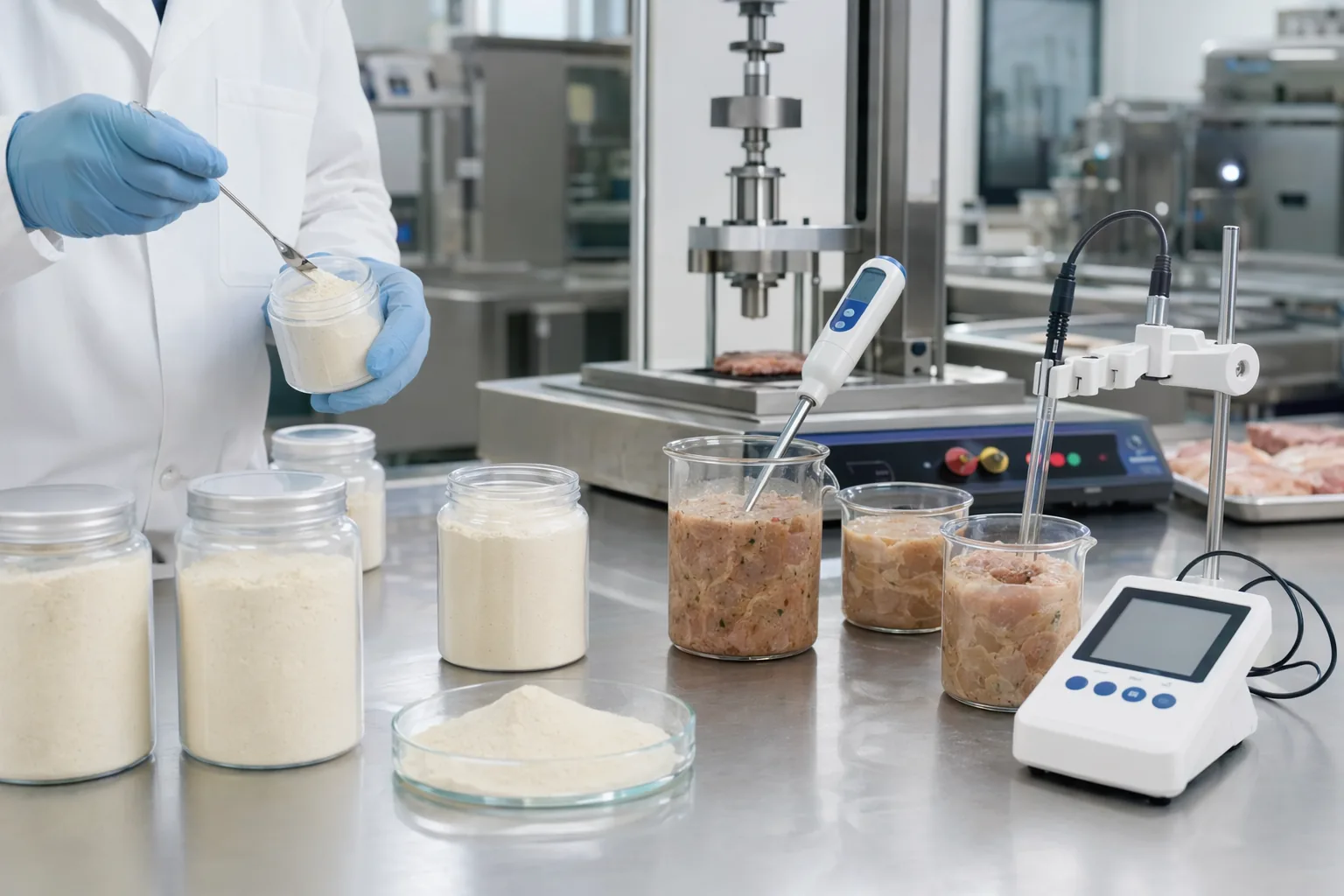
For meat processors and ingredient formulators, papain enzyme powder offers controlled protein hydrolysis when dosage, contact time, pH, and heat inactivation are validated at plant scale.
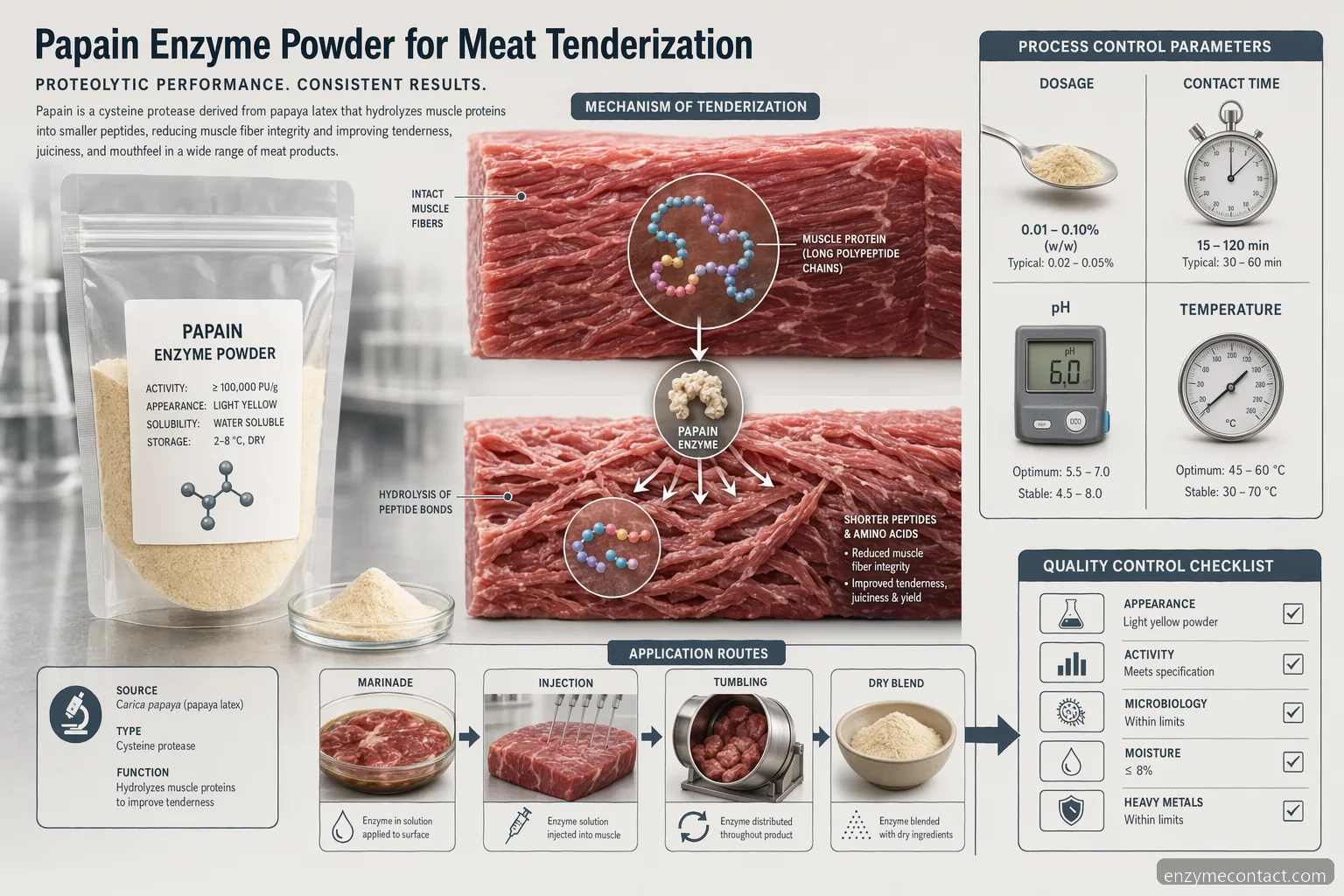
Why processors buy papain enzyme powder
Industrial buyers searching to buy papain enzyme powder are usually solving a formulation problem: achieving repeatable tenderness without excessive purge, mushy texture, or inconsistent eating quality. Papain is a cysteine protease derived from papaya latex and is valued because it can hydrolyze myofibrillar and connective-tissue proteins under food-processing conditions. In meat tenderization, it may be used in dry seasoning blends, liquid marinades, injection brines, vacuum tumbling, or surface treatments. The key is not simply adding more papain enzyme powder; it is matching enzyme activity, contact time, meat cut, particle size, temperature, salt level, and final thermal process. For B2B procurement, the purchasing specification should define activity units, carrier, moisture, microbiological limits, heavy metals where relevant, and documentation requirements. Buyers comparing papain enzyme powder for sale should evaluate performance per batch, not only price per kilogram.
Best fit: beef, poultry, pork, and value-added marinated products. • Common formats: spray-dried powder, standardized powder, and blend-ready enzyme systems. • Primary buying metric: cost-in-use at the target tenderness and yield.
Formulation conditions for meat tenderization
Papain enzyme performance is controlled by pH, temperature, water availability, and time. For early trials, many processors evaluate pH 5.5-7.5, with strongest practical activity often observed around mildly acidic to neutral conditions, depending on the papain enzyme powder grade and meat matrix. Temperatures from refrigerated marination to warm processing can be tested, but higher temperatures accelerate hydrolysis and increase the risk of over-tenderization. A conservative pilot range is 20-200 ppm of enzyme powder based on meat weight, or 0.01-0.08% in brine systems, then adjusted according to declared activity units and sensory targets. Contact time may range from 30 minutes in intensive tumbling to overnight chilled marination. The final cook step should be validated to reduce residual activity, typically through internal product temperatures used in the plant’s approved process.
Start low, then increase dosage based on texture and yield data. • Validate pH after all salts, phosphates, acids, and seasonings are included. • Avoid uncontrolled warm holding that can produce soft or pasty texture.
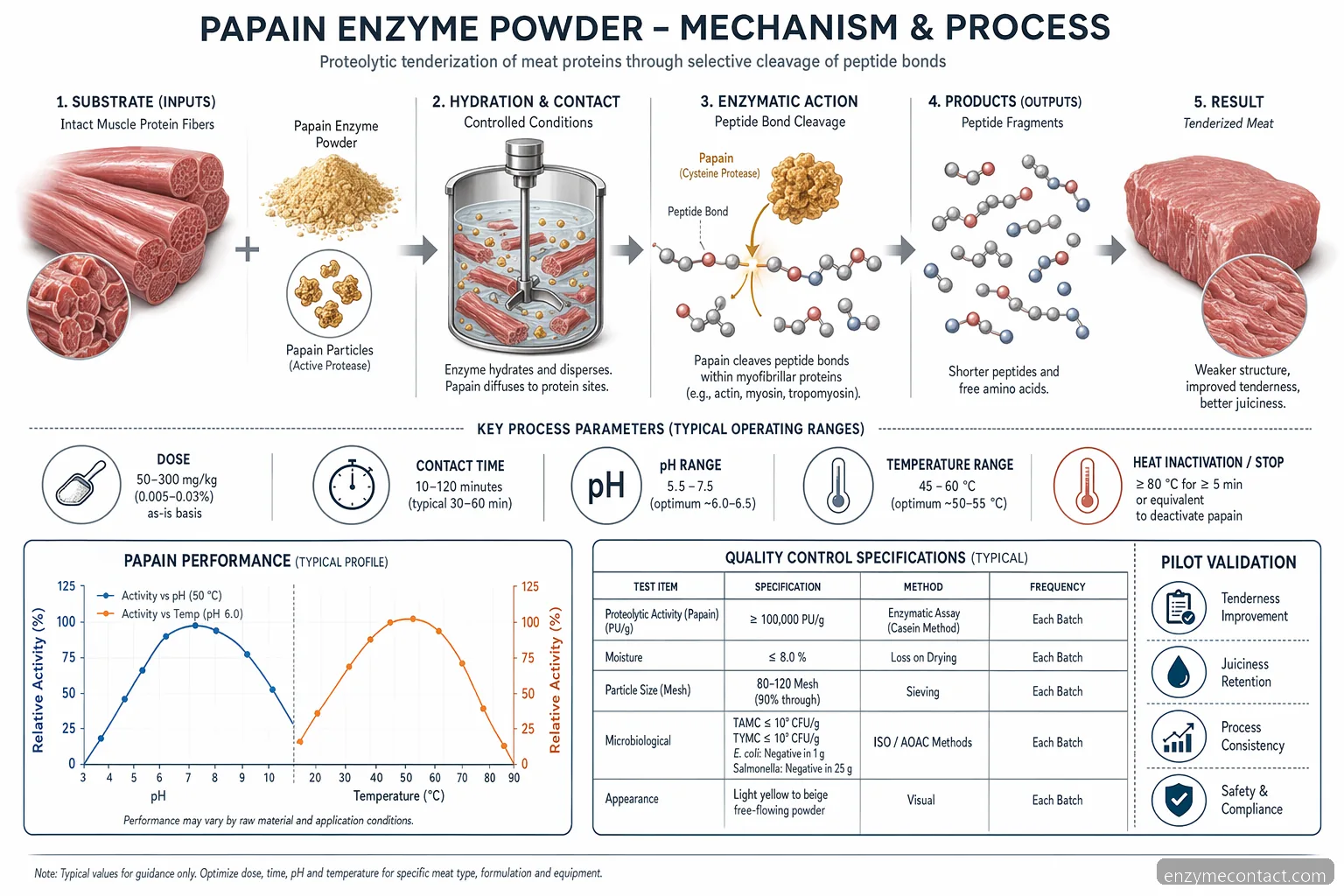
Process routes: marinade, injection, tumble, or dry blend
The right application route depends on product geometry and desired penetration. Marinades are suitable for strips, diced meat, and thin cuts where diffusion distance is short. Injection brines improve distribution in whole-muscle products but require attention to enzyme solubility, filtration, needle blockage, and brine stability. Vacuum tumbling can improve uptake and uniformity, especially when papain enzyme powder is pre-dispersed into the aqueous phase rather than added directly to meat. Dry blends are convenient for seasoning manufacturers, but enzyme segregation and localized hot spots must be controlled through particle-size matching and validated blending. If your sourcing team compares terms such as papain enzyme, papaya enzyme, enzym papain, enzyme powder papain, or wholesale papain enzyme powder, the technical decision should still be based on the same manufacturing reality: the enzyme must disperse uniformly, act predictably, and stop acting when the process requires it.
Pre-hydrate or disperse powder to reduce clumping. • Check compatibility with salt, phosphate, acids, smoke flavors, and spices. • Confirm equipment cleanout to prevent carryover into non-enzyme products.
QC checks for pilot validation
Pilot validation should connect laboratory enzyme activity to finished-product quality. Begin with a control batch and at least two dosage levels of the selected papain enzyme powder. Measure marinade or brine pH, uptake, purge loss, cook yield, sliceability, and texture. Instrumental methods may include Warner-Bratzler shear force, texture profile analysis, or a plant-approved compression test. Sensory review should focus on tenderness, juiciness, fibrousness, and any soft or mealy defects. Microbiological controls remain essential because enzymes are not a substitute for hygiene, temperature control, or validated lethality steps. Retain samples from different storage points to confirm that residual activity does not continue to degrade texture during shelf life. A robust trial report helps purchasing and R&D compare suppliers, including sources offering papain enzyme powder Taiwan origin or other regional supply options.
Track enzyme lot, activity units, dosage, pH, temperature, and time. • Measure texture at day 0 and after intended shelf-life storage. • Confirm final process inactivation under real product load conditions. • Document reject limits for mushiness, purge, and yield loss.
Supplier qualification and cost-in-use
When you buy papain enzyme powder for industrial meat applications, supplier qualification should be as rigorous as formula development. Request a current COA, TDS, and SDS for each candidate grade. The COA should identify batch number, activity, moisture, microbiological values, and any agreed contaminant or purity tests. The TDS should state recommended storage, handling, solubility, pH and temperature guidance, carriers, and activity assay method. The SDS supports safe handling because protease powders can irritate skin, eyes, or the respiratory tract if poorly controlled. Commercial comparison should be made on cost-in-use: dosage required to reach the texture target, yield impact, rework risk, lead time, packaging, shelf life, and batch consistency. Avoid approving a product solely because it appears as papain enzyme powder for sale at a lower unit price; under-standardized activity can cost more in failed batches.
Qualify at least two supply options where continuity is critical. • Ask how activity is standardized and how batch variation is controlled. • Review storage conditions and remaining shelf life before bulk purchase. • Require pilot approval before full-scale production release.
Technical Buying Checklist
Buyer Questions
There is no universal dosage because activity units, meat cut, particle size, brine level, pH, temperature, and contact time all change the result. A practical pilot range is 20-200 ppm powder on meat weight, or 0.01-0.08% in brine systems. Start low, benchmark against an untreated control, and increase only when texture, purge, and yield data support the change.
Papain enzyme powder should usually be dispersed into the aqueous phase before contact with meat to avoid clumps and local over-treatment. Confirm solubility, brine pH, filtration requirements, and compatibility with salt, phosphate, acids, flavors, and spices. For injection systems, check needle blockage and distribution. For tumbling, record vacuum level, time, temperature, uptake, and final texture.
A qualified papain supplier should provide a COA, TDS, and SDS for the exact grade and batch under review. Buyers should also request the activity assay method, carrier or diluent information, storage and shelf-life guidance, packaging details, and agreed microbiological limits. These documents help R&D, QA, procurement, and plant operations compare wholesale papain enzyme powder options consistently.
Compare suppliers by cost-in-use, not only price per kilogram. Review activity consistency, dosage needed to reach the texture target, yield impact, lead time, documentation quality, packaging suitability, shelf life, and technical support during pilot trials. A lower-cost powder can be more expensive if it causes over-tenderization, high purge, poor batch repeatability, or extra plant troubleshooting.
Papain for Research & Industry
Need Papain for your lab or production process?
ISO 9001 certified · Food-grade & research-grade · Ships to 80+ countries
Frequently Asked Questions
What is the best dosage when using papain enzyme powder in meat?
There is no universal dosage because activity units, meat cut, particle size, brine level, pH, temperature, and contact time all change the result. A practical pilot range is 20-200 ppm powder on meat weight, or 0.01-0.08% in brine systems. Start low, benchmark against an untreated control, and increase only when texture, purge, and yield data support the change.
How should papain be added to an injection brine or marinade?
Papain enzyme powder should usually be dispersed into the aqueous phase before contact with meat to avoid clumps and local over-treatment. Confirm solubility, brine pH, filtration requirements, and compatibility with salt, phosphate, acids, flavors, and spices. For injection systems, check needle blockage and distribution. For tumbling, record vacuum level, time, temperature, uptake, and final texture.
What documents should a papain supplier provide for B2B approval?
A qualified papain supplier should provide a COA, TDS, and SDS for the exact grade and batch under review. Buyers should also request the activity assay method, carrier or diluent information, storage and shelf-life guidance, packaging details, and agreed microbiological limits. These documents help R&D, QA, procurement, and plant operations compare wholesale papain enzyme powder options consistently.
How do we compare papain enzyme powder suppliers beyond price?
Compare suppliers by cost-in-use, not only price per kilogram. Review activity consistency, dosage needed to reach the texture target, yield impact, lead time, documentation quality, packaging suitability, shelf life, and technical support during pilot trials. A lower-cost powder can be more expensive if it causes over-tenderization, high purge, poor batch repeatability, or extra plant troubleshooting.
Related: Papain Powder for Commercial Processing
Turn This Guide Into a Supplier Brief Request papain enzyme powder specifications, samples, and pilot-formulation support for your meat tenderization project. See our application page for Papain Powder for Commercial Processing at /applications/papain-powder-commercial/ for specs, MOQ, and a free 50 g sample.
Contact Us to Contributehello@mail.enzymecontact.com