Enzym Papain for Industrial Meat Tenderization
Troubleshoot papain enzyme meat tenderization with dosage bands, pH, temperature, QC checks, COA/TDS/SDS review, and supplier qualification.
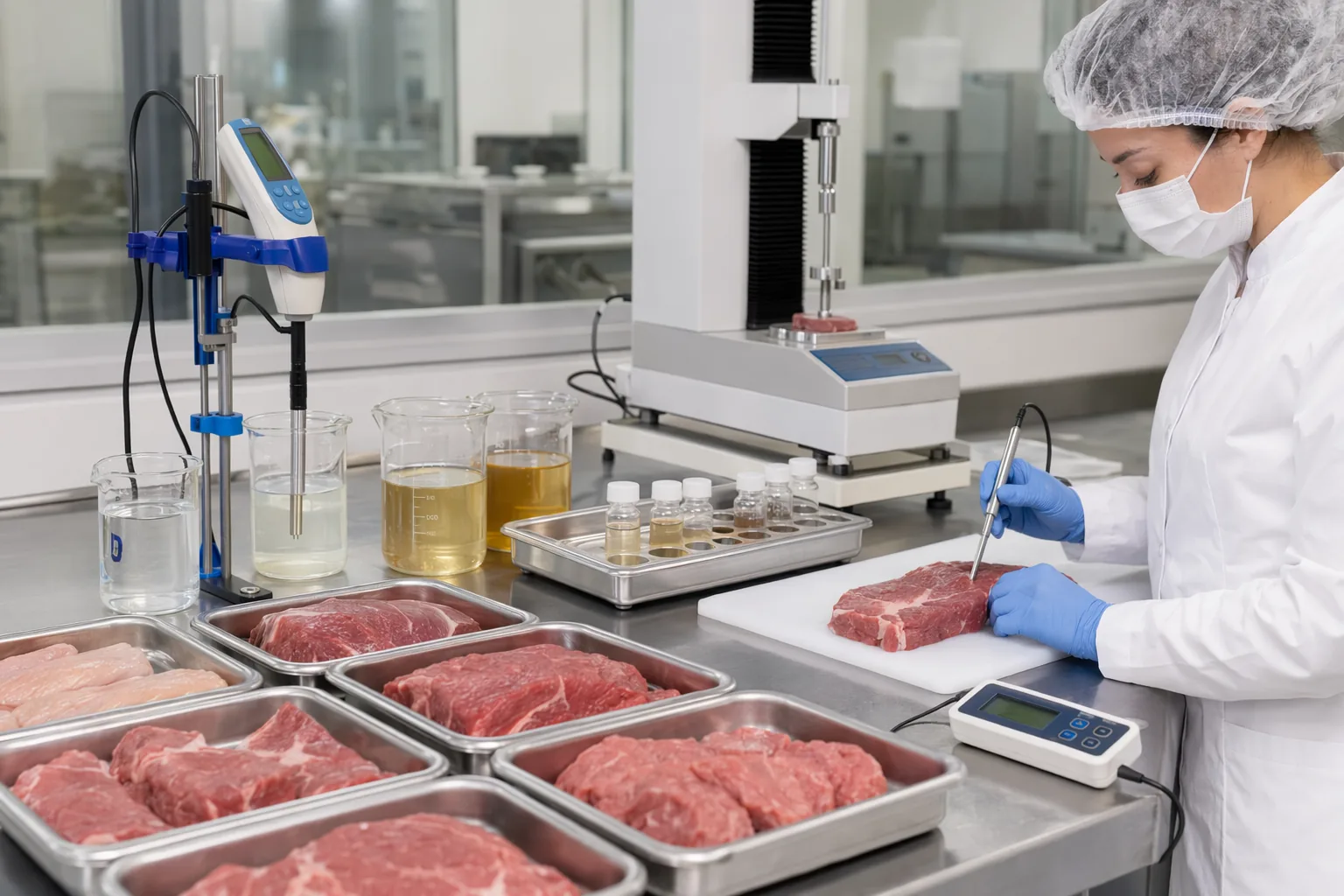
Practical guidance for processors troubleshooting papain performance, texture variation and cost-in-use in meat tenderization lines. To request a wholesale quote, send the grade or activity you need, the quantity per order or per month, and the destination country to hello@mail.enzymecontact.com, or use the quote form on our home page.
Why papain performance varies in meat plants
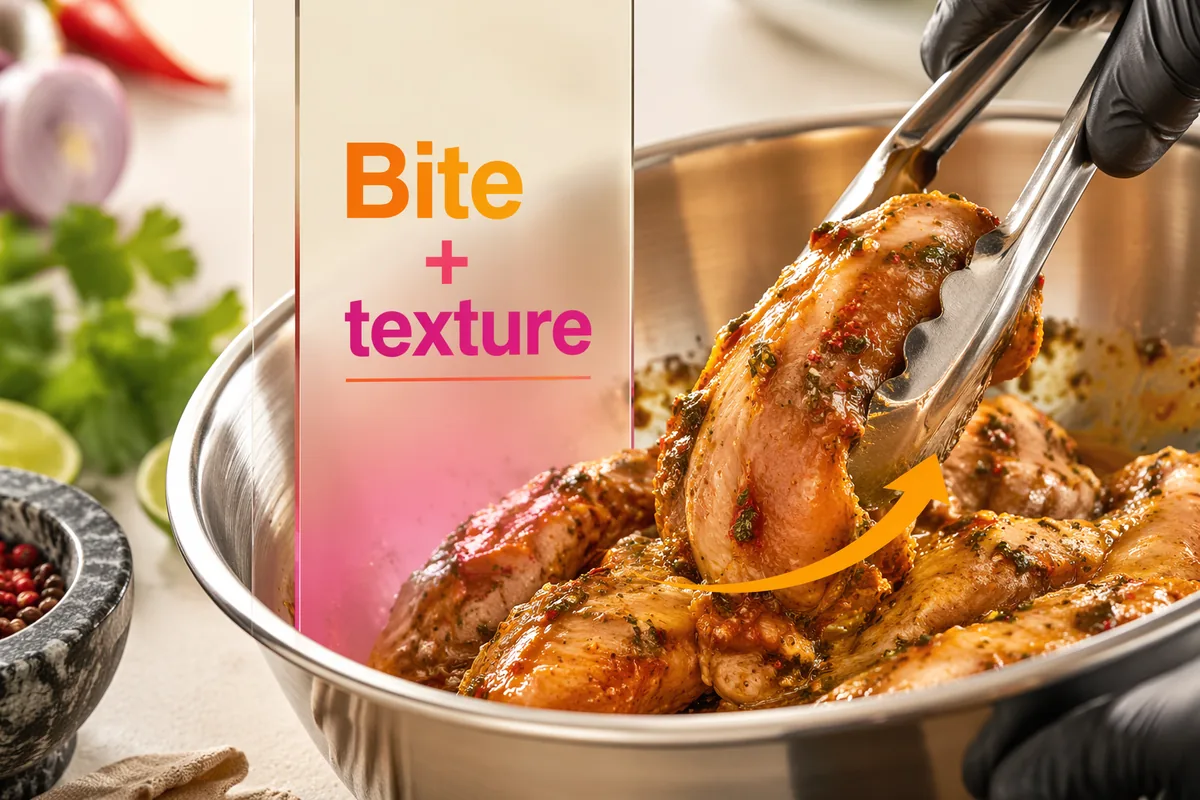
Papain is a proteolytic papaya enzyme used to hydrolyze muscle proteins and connective tissue, improving bite and processing consistency. In industrial meat tenderization, troubleshooting usually starts when the same papain enzyme addition gives different texture results across lots, species, cuts, marinades, or cook profiles. Variation can come from raw material age, fat level, collagen content, injection pickup, tumbler efficiency, brine pH, salt level, and time before thermal processing. The phrase enzym papain is often searched alongside consumer terms, but B2B purchasing should focus on activity, process fit, safety documentation, and reproducibility. A papain supplier should define activity units, recommended conditions, carrier ingredients, solubility, and storage stability. Buyers should avoid comparing products by price per kilogram alone because potency, formulation strength, and dosage efficiency can differ significantly.
Texture depends on both enzyme activity and meat substrate variability. • Compare suppliers by activity-normalized cost-in-use, not only unit price. • Confirm whether the product is powder, liquid, or formulated blend.
Starting dosage bands for pilot trials
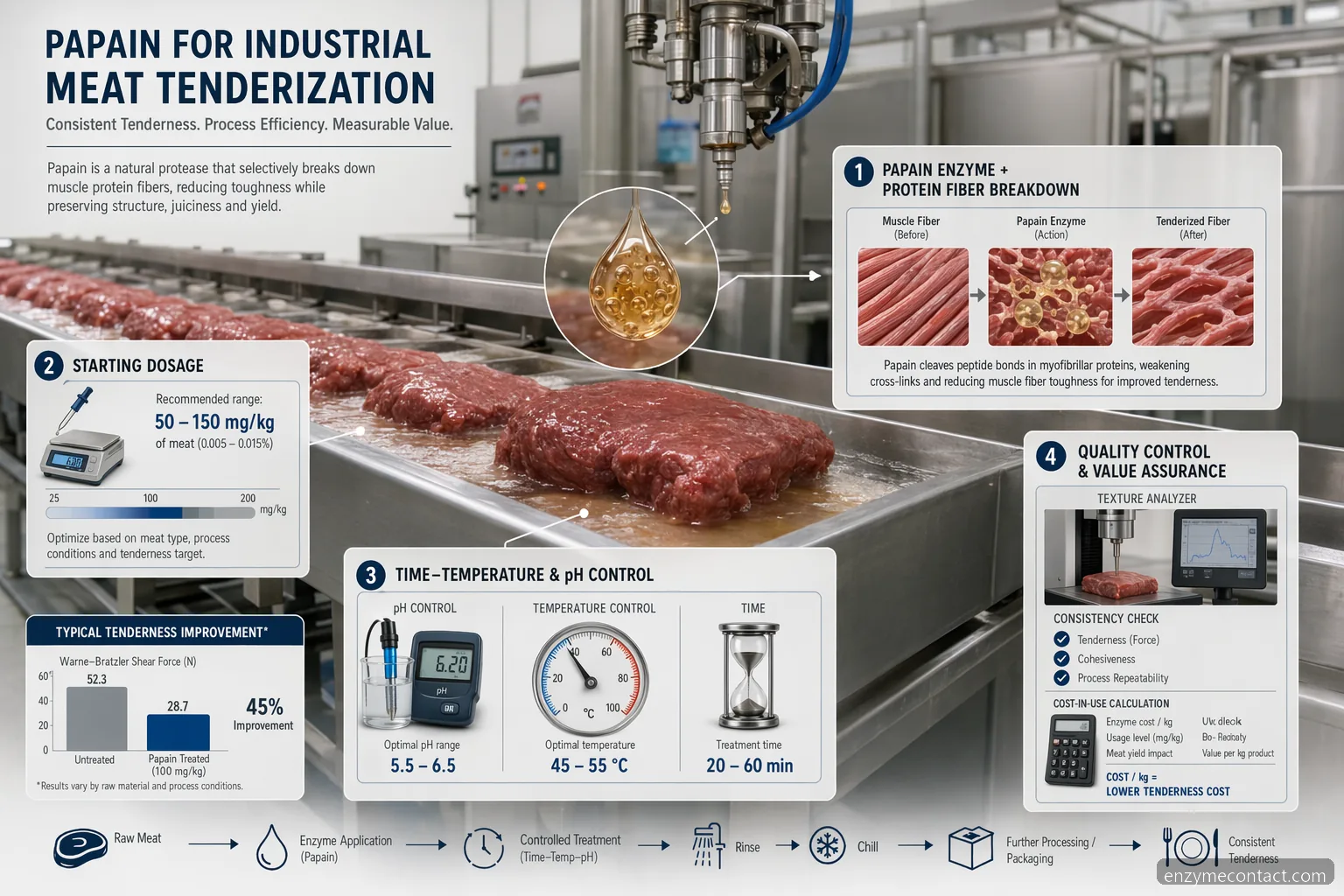
A safe pilot starting range for papain enzyme preparations is commonly 0.02–0.20% by meat weight, or lower when using high-activity concentrates. For injection or tumbling systems, begin at the low end and evaluate texture after the full intended dwell and cook cycle. If dosing by activity, ask the supplier for the assay method and units per gram, then calculate target addition on an activity basis rather than assuming all papain products are equivalent. Overdosing can cause mushy texture, purge increase, sliceability loss, or irregular bite, especially in thin cuts or extended marination. Underdosing may show little improvement in tenderness, particularly in high-collagen material. Pilot trials should include at least one untreated control, one low dose, one mid dose, and one upper-limit dose under the same brine, temperature, and dwell conditions.
Typical screening band: 0.02–0.20% enzyme preparation by meat weight. • Use activity units when available for more accurate comparison. • Keep brine composition and mechanical action constant during trials. • Record injection pickup, tumbler time, and dwell time before cooking.
pH, temperature, and time controls
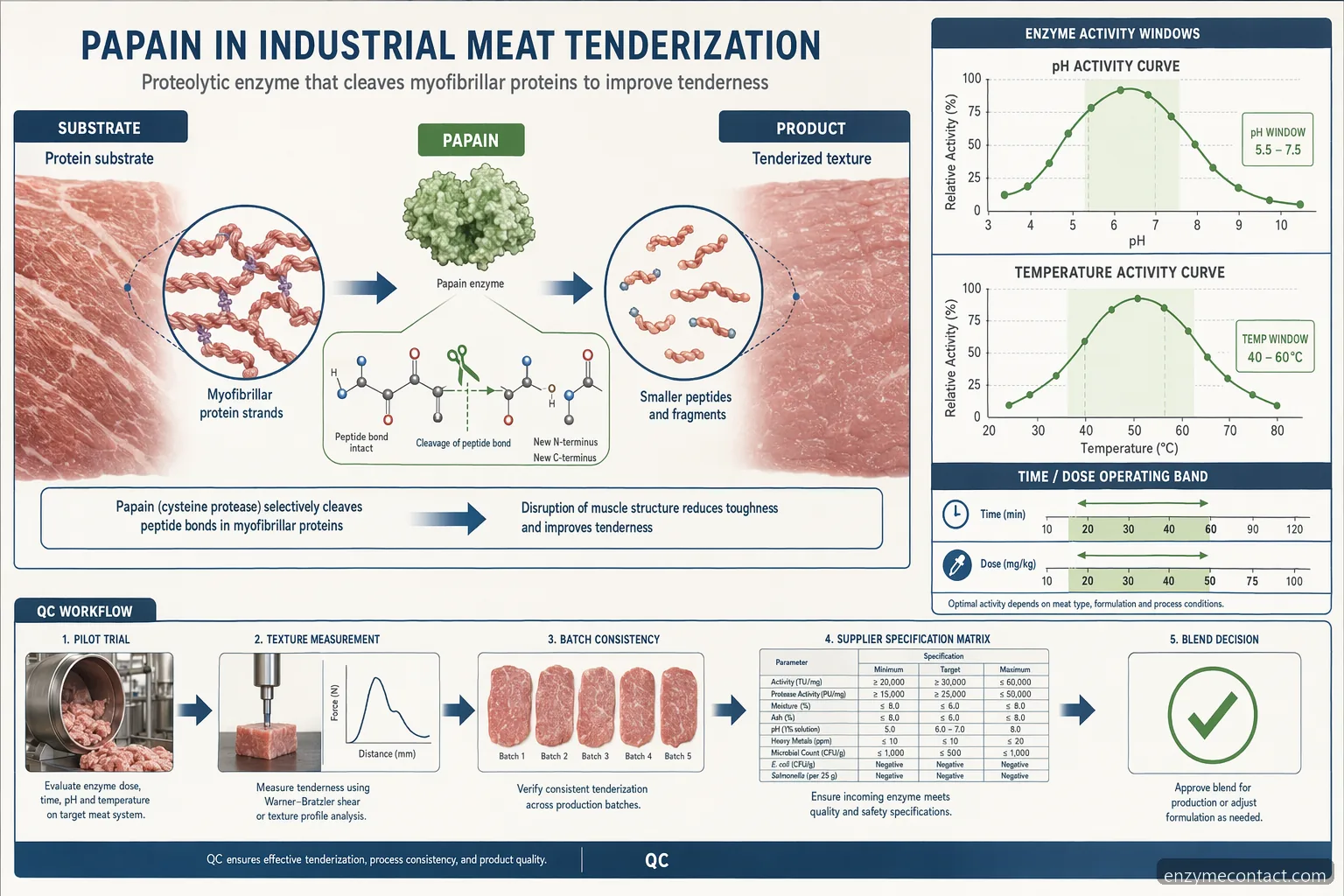
Papain enzym wirkung is strongly influenced by pH, temperature, and contact time. In meat systems, practical activity is often observed around pH 5.5–7.0, depending on the formulation and substrate. Activity generally increases with temperature up to moderate heat, then falls as the enzyme is denatured; check the working range on the TDS of the grade you buy. However, meat processing rarely holds enzyme-only conditions; salt, phosphates, acids, sugars, and proteins can shift performance. For cold marination, the reaction is slower but still continues over time, so dwell control matters. For cooked products, processors often rely on the cook step to reduce remaining activity, but heat penetration must be validated. If the core temperature rises slowly, papain may keep acting during warm-up and cause excessive softening before inactivation.
Useful process pH screening range: 5.5–7.0. • Evaluate warm-step activity only where process design and food safety allow. • Cold dwell extends reaction time even at reduced reaction speed. • Validate inactivation using the actual product geometry and cook profile.
QC checks for consistent tenderness
Tenderization should be measured with defined QC checks rather than subjective bite tests alone. Common controls include raw material specification, brine pH, enzyme solution concentration, mixing time, injection pickup, tumbler load, dwell temperature, dwell duration, cook yield, purge, sliceability, and finished texture. Texture analyzers, shear force methods, sensory panels, or internal bite scoring can be used if the method is documented and repeatable. For troubleshooting, collect data by lot and compare results to enzyme batch numbers from the COA. If one lot performs differently, review storage temperature, exposure to humidity, age from manufacture, and whether the enzyme was pre-dissolved for too long before use. Papain enzym kaufen decisions should include technical support for trial design and failure analysis, not only commercial availability.
Track enzyme lot number against finished texture results. • Measure brine pH before enzyme addition and before use. • Document hydration time and solution holding conditions. • Use objective texture or shear testing where possible.
Activity units and assay method matter
Papain enzyme activity can be reported using different assay substrates, units, and test conditions, so two products with the same number on a label may not perform equally. Ask the papain supplier to explain the assay method used on the COA and how it correlates with meat tenderization performance. Common assay conditions may use casein, hemoglobin, or synthetic substrates at defined pH and temperature; these do not exactly match meat systems but are useful for lot release and comparison. Request typical activity range, minimum guaranteed activity, moisture, ash, heavy metals if relevant to your market, and microbial limits appropriate for food processing. If the supplier cannot provide the test method or release criteria, cost-in-use calculations become unreliable.
Avoid comparing activity values from different assay methods as if they are identical. • Ask for the minimum guaranteed activity at shelf-life end, if available. • Request recent COA examples from multiple lots. • Confirm whether carriers or diluents affect dosing accuracy.
Supplier qualification and cost-in-use
For industrial procurement, a qualified papain supplier should provide a current COA, TDS, SDS, declared activity method, recommended storage conditions, ingredient declaration, country of origin, allergen statement, and lot traceability. The TDS should state dosage guidance and process compatibility, while the SDS should support safe handling for powders or liquids. Cost-in-use should be calculated from the effective dose needed to meet texture specifications, including yield impact, rework risk, labor, and line downtime. A lower-priced product can be more expensive if it needs a higher addition rate or causes inconsistent results. Avoid treating papain enzym kapseln or supplement-oriented searches as a basis for factory purchasing. For industrial meat applications, request food-processing grade documentation, pilot samples, technical discussion, and validation data under your own process conditions.
Request COA, TDS, SDS, activity method, and lot traceability. • Calculate cost per treated kilogram at validated dosage. • Confirm storage stability and handling requirements. • Run pilot validation before full production conversion.
When blends make sense
Some processors evaluate an enzym komplex mit bromelain und papain because different proteases can act differently on muscle and connective tissue proteins. A blend may broaden tenderization effect, but it also increases the need for controlled validation. Bromelain and papain may have different activity profiles, heat sensitivity, and substrate preferences, so substitution should not be made by equal weight without testing. For B2B production, the goal is not maximum protein breakdown; it is repeatable texture within a saleable specification. If a blend is considered, run side-by-side trials against single papain at equal cost-in-use and equal activity contribution where possible. Check whether the blend changes flavor, purge, yield, allergen declarations, or labeling requirements in the target market before scale-up.
Compare blends against single-enzyme papain under identical conditions. • Do not substitute by weight without activity and process validation. • Review labeling and declaration requirements for all added components.
Papain for Research & Industry
Need Papain for your lab or production process?
ISO 9001 certified · Food-grade & research-grade · Ships to 80+ countries
Frequently Asked Questions
What is the best papain dosage for meat tenderization?
There is no universal best dosage because papain enzyme activity, meat cut, collagen level, pH, temperature, and dwell time all affect results. A practical pilot screen is 0.02–0.20% enzyme preparation by meat weight, or an activity-based equivalent for concentrates. Start low, include an untreated control, and increase only until the target texture is reached without purge, mushiness, or sliceability loss.
Why did papain make the meat too soft?
Excessive softening usually comes from too much enzyme activity, too long a dwell time, uneven distribution, slow heat inactivation, or high activity during warm-up. Check the dosage calculation, enzyme activity units, brine pH, holding temperature, injection pickup, and cook profile. Compare the affected batch with COA lot data and storage records to see whether potency or handling changed.
Can papain be used in injection brines and tumbling systems?
Yes, papain can be used in injection, tumbling, or surface-applied systems when it is compatible with the formulation and equipment. The key controls are solubility, complete dispersion, brine pH, uniform pickup, dwell time, and sanitation procedures. Confirm whether the papain supplier recommends pre-hydration, direct addition, or controlled dosing, and validate that filters or injectors do not clog.
How should we compare two papain suppliers?
Compare papain suppliers by activity-normalized performance, documentation, consistency, and support. Request COA, TDS, SDS, activity assay method, lot traceability, storage guidance, and ingredient declaration. Then run side-by-side pilot trials at equivalent activity or equivalent cost-in-use. The better supplier is the one that meets texture, yield, handling, safety, and repeatability requirements under your process conditions.
Is papain the same as papaya enzyme?
Papain is a protease derived from papaya latex, so it is often called papaya enzyme in general search language. For industrial purchasing, the important details are not the common name but the declared enzyme activity, formulation type, carrier ingredients, purity suitable for the intended food process, and technical documentation. Always qualify the exact commercial product rather than assuming all papaya enzyme materials behave alike.
Should we buy a papain and bromelain blend instead?
A papain and bromelain blend can be useful if trials show better texture control or cost-in-use than papain alone. However, blends are not automatically superior and should not be substituted by equal weight. Validate pH, temperature, dwell time, flavor impact, purge, yield, labeling implications, and inactivation behavior. Side-by-side pilot testing is the safest way to choose.
Is papain enzym kapseln relevant to B2B meat processing?
No. Searches such as papain enzym kapseln usually refer to consumer capsule formats and are not a specification basis for food manufacturing. Industrial meat processors should evaluate food processing papain with defined activity, carrier, documentation, traceability, and handling requirements. Procurement should focus on process performance, quality documentation, regulatory suitability for the target market, and cost-in-use rather than consumer supplement presentation or dosage language.
Request a Wholesale Quote for Papain
Send the grade or activity, quantity and destination country. We quote 1 kg, 5 kg and 25 kg packs for meat processors and resellers, with a free sample for qualified inquiries. Specification: /applications/papain-powder-commercial/. Request papain samples, COA/TDS/SDS, and pilot support for your meat tenderization process. See our application page for Papain Powder for Commercial Processing at /applications/papain-powder-commercial/ for specs, MOQ, and a free 50 g sample.
Contact Us to Contributehello@mail.enzymecontact.com