Papain Enzyme Supplier for Meat Tenderization
Source papain enzyme for meat tenderization with practical dosage, pH, temperature, QC, COA/TDS/SDS, pilot validation, and supplier checks.
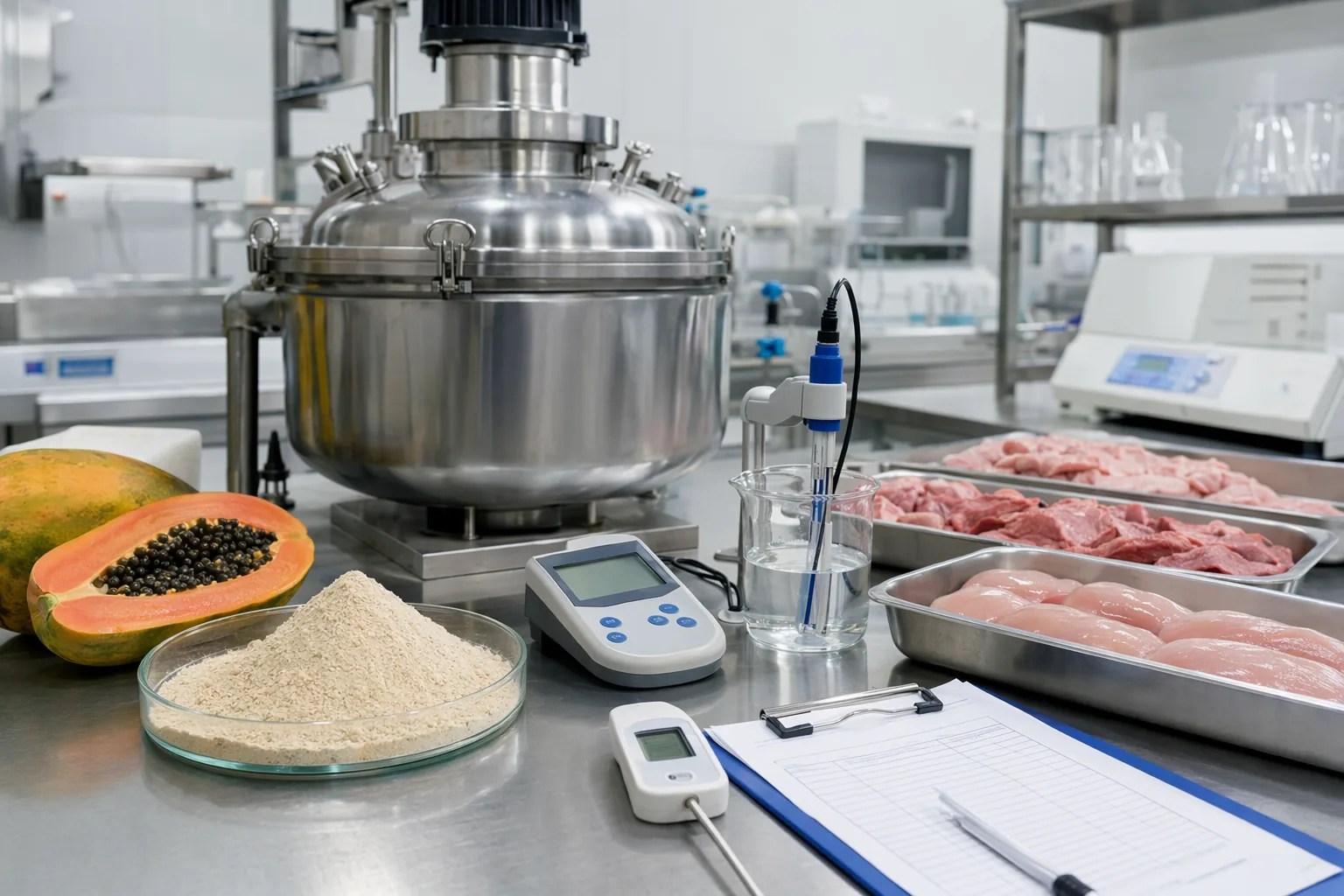
A practical sourcing and process guide for B2B buyers using papaya-derived papain enzyme to improve meat tenderness while controlling yield, texture, cost-in-use, and quality risk.
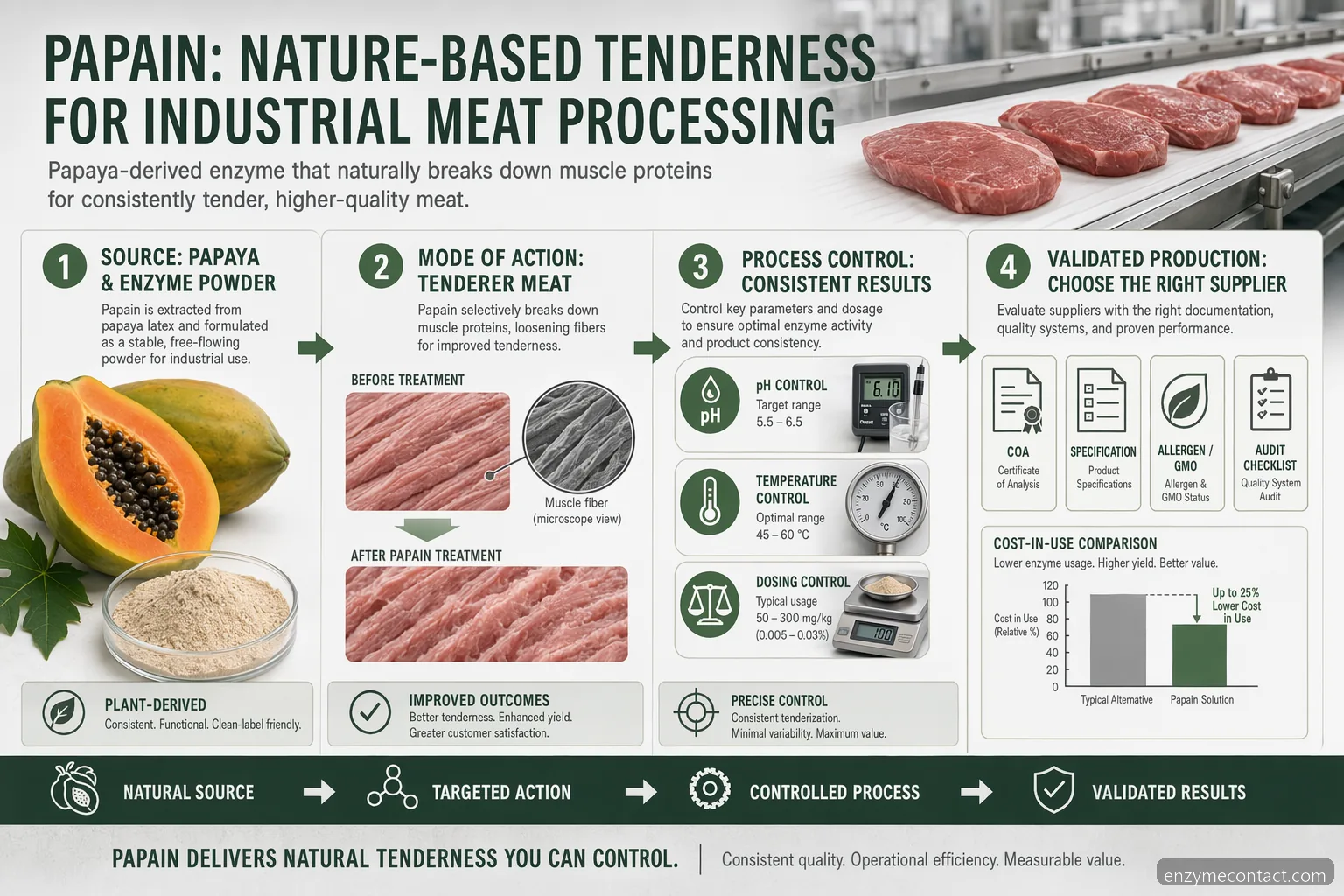
Why Papain Is Used in Industrial Meat Tenderization
Papain is a proteolytic enzyme obtained from papaya latex and used to hydrolyze muscle proteins that contribute to toughness. In meat tenderization, it can be applied through marinades, injection brines, tumbling systems, surface treatment, or controlled pre-cook processing. For B2B buyers, the goal is not simply to soften meat, but to achieve repeatable bite, acceptable sliceability, stable yield, and consistent labeling or regulatory compliance for the target market. Compared with mechanical tenderization alone, papain enzyme can help processors work with variable raw material, but excessive dose or contact time may produce mushy texture and purge. A capable papain enzyme supplier should therefore support trials based on the processor’s cut type, pH, salt level, phosphate use, processing temperature, and thermal step. This article focuses on application conditions for meat tenderization, while recognizing that buyers may also source papain for brewing, pharmaceutical, cosmetic, or enzyme papain research uses.
Common formats include powder, granule, and liquid preparations. • Key control points are dosage, distribution, time, temperature, and inactivation. • Tenderness must be balanced against yield, bite, and product identity.
Recommended Process Conditions for Trial Design
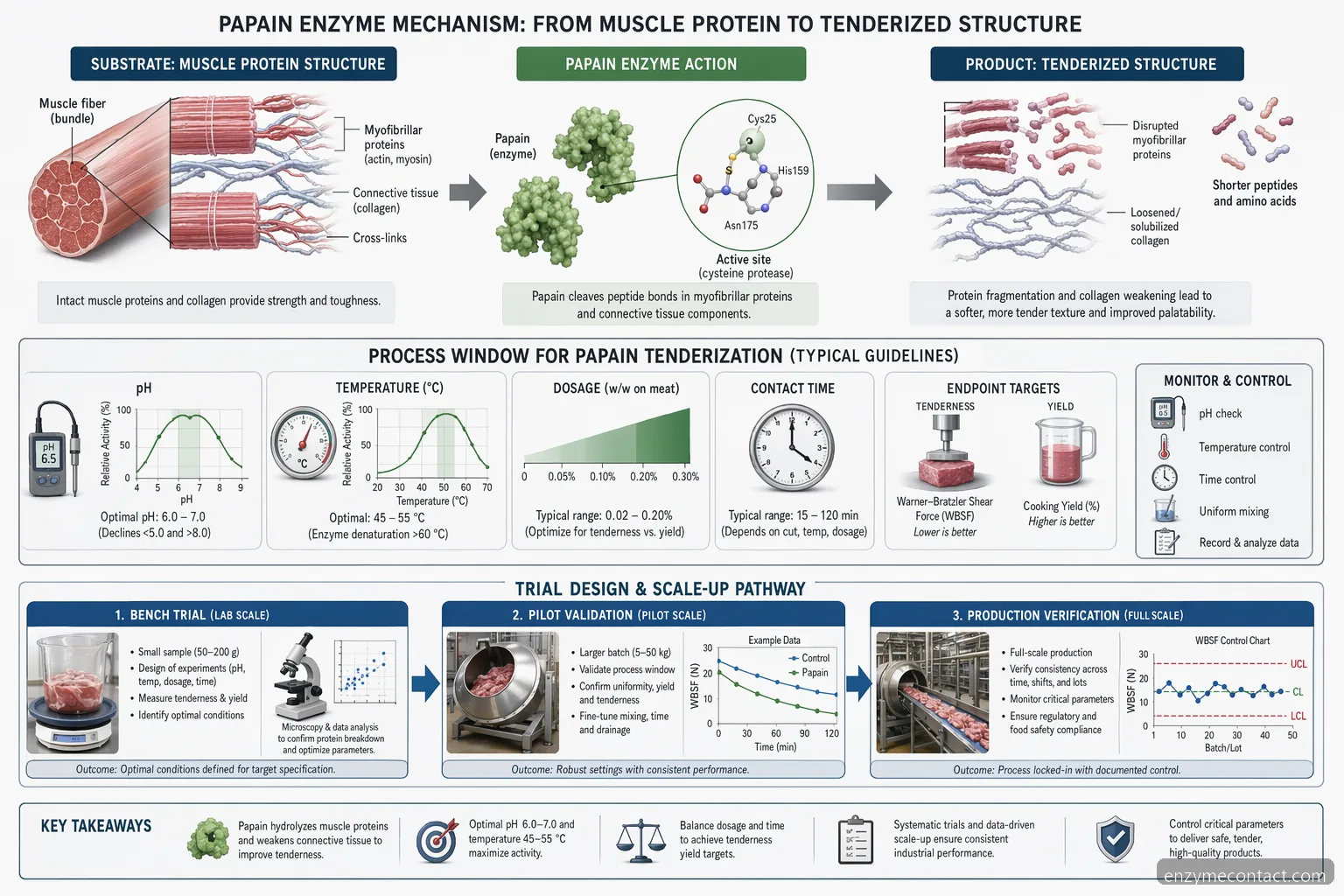
Papain activity is generally useful across mildly acidic to neutral systems, with many meat applications evaluated around pH 5.5 to 7.0. Activity increases with temperature, but industrial meat processing often applies the enzyme during refrigerated or chilled handling to control microbial risk and slow reaction rate. A practical first trial may screen 50 to 300 ppm of papain enzyme preparation as supplied, or about 0.005% to 0.03% depending on activity strength, followed by adjustment based on the supplier’s declared units. For injected or tumbled products, uniform brine dispersion is essential; for surface-applied products, penetration depth must be validated. Contact time can range from minutes to several hours, depending on temperature and cut size. The cooking step often reduces residual activity, but each processor should confirm inactivation under its own core temperature and hold-time profile rather than relying on generic assumptions.
Typical trial pH: 5.5–7.0, adjusted to the meat system. • Initial screening: 50–300 ppm as supplied, then refine by activity units. • Validate heat inactivation using actual product geometry and cook schedule.
Quality Documents to Request from a Papain Enzyme Supplier
Supplier qualification should begin with documentation, not just a quotation. Request a current Certificate of Analysis for the offered lot, a Technical Data Sheet describing activity units and recommended handling, and a Safety Data Sheet for occupational safety review. The COA should identify the enzyme activity method, appearance, moisture or loss on drying where applicable, microbiological results for food use, and any relevant contaminant checks required by the buyer’s market. The TDS should state storage conditions, shelf life basis, solubility or dispersibility, carrier information when relevant, and practical application guidance. If the same supplier offers papain enzyme supplier for pharmaceutical, papain enzyme supplier for brewing, papain enzyme supplements, or papain enzyme exfoliator grades, confirm that the offered material is specifically suitable for food processing and not merely a cross-market listing. Avoid accepting unsupported quality claims without documents and lot traceability.
Request COA, TDS, SDS, activity method, and lot traceability. • Check food-grade suitability for the intended country or customer requirement. • Confirm carriers, anti-caking agents, and any processing aids.
Pilot Validation: From Bench Test to Production Line
A good pilot plan compares at least one untreated control with two or three papain dosages under realistic plant conditions. Measure texture using a consistent shear, compression, or sensory method, and record purge, cook yield, sliceability, color, flavor impact, and batch-to-batch variation. For injected products, track pick-up percentage and brine distribution; for tumbling, document vacuum level, time, temperature, and rotation program. Pilot validation should also include hold-time abuse scenarios that may occur in the plant, because papain can continue acting before heat inactivation. When selecting a papain enzyme supplier for meat tenderization, ask whether the supplier can help interpret trial results and adjust dose by activity units rather than simply increasing addition rate. A successful trial should define a processing window, not a single ideal condition, so operators can manage raw material variation without over-tenderizing product.
Run untreated controls and multiple dosage levels. • Measure texture, purge, cook yield, and sensory acceptance. • Include realistic hold times and temperature variation.
Cost-in-Use and Supplier Comparison
The lowest price per kilogram is rarely the lowest cost-in-use. Papain enzyme products may differ in declared activity, carrier level, dusting behavior, solubility, storage stability, and technical support. Compare suppliers by calculating enzyme cost per metric ton of finished meat at the validated dosage, then include effects on yield, downgrade risk, rework, and quality holds. A stronger papain preparation may require lower addition, but only if it disperses well and delivers consistent activity lot after lot. For international purchasing, also evaluate lead time, packaging integrity, minimum order quantity, documentation responsiveness, and replacement policy for out-of-spec lots. Buyers searching terms such as papain, papaya enzyme, enzym papain, or papain enzyme supplier should request the same core information from each candidate. Standardized comparison makes commercial negotiation easier and reduces the risk of switching to a product that performs differently on the line.
Calculate cost per ton of finished product, not only price per kilogram. • Normalize quotes by enzyme activity and validated dosage. • Include logistics, documentation speed, and lot consistency.
Technical Buying Checklist
Buyer Questions
A practical starting screen is often 50–300 ppm of papain enzyme preparation as supplied, but the correct level depends on declared activity, meat cut, brine composition, temperature, contact time, and target texture. Run pilot trials with an untreated control and at least two dosage levels. Final dosage should be based on tenderness, purge, yield, sensory results, and heat inactivation validation.
A qualified supplier should provide a lot-specific COA, TDS, SDS, declared activity method, storage guidance, shelf life, packaging details, and traceability information. For food processing, buyers should also request relevant microbiological data and statements needed for their market. If the supplier serves pharmaceutical, brewing, supplement, or cosmetic sectors, confirm that the offered grade is appropriate for meat processing.
Papain may be used in different industries, including brewing clarification or pharmaceutical processing, but grade requirements and documentation expectations differ. A papain enzyme supplier for brewing or a papain enzyme supplier for pharmaceutical applications may offer different specifications, carriers, and quality systems. Meat processors should buy material qualified for their own application and regulatory market, rather than assuming interchangeability across uses.
Over-tenderization is controlled by lowering dose, improving dispersion, shortening contact time, managing chilled temperatures, and validating the cooking step that reduces enzyme activity. The risk is highest when product waits longer than expected before thermal processing or when brine distribution is uneven. Pilot trials should include realistic production delays so the approved process has a safe operating window.
Papain for Research & Industry
Need Papain for your lab or production process?
ISO 9001 certified · Food-grade & research-grade · Ships to 80+ countries
Frequently Asked Questions
What dosage should a meat processor use for papain enzyme?
A practical starting screen is often 50–300 ppm of papain enzyme preparation as supplied, but the correct level depends on declared activity, meat cut, brine composition, temperature, contact time, and target texture. Run pilot trials with an untreated control and at least two dosage levels. Final dosage should be based on tenderness, purge, yield, sensory results, and heat inactivation validation.
What documents should a papain enzyme supplier provide?
A qualified supplier should provide a lot-specific COA, TDS, SDS, declared activity method, storage guidance, shelf life, packaging details, and traceability information. For food processing, buyers should also request relevant microbiological data and statements needed for their market. If the supplier serves pharmaceutical, brewing, supplement, or cosmetic sectors, confirm that the offered grade is appropriate for meat processing.
Can the same papain enzyme be used for brewing or pharmaceutical applications?
Papain may be used in different industries, including brewing clarification or pharmaceutical processing, but grade requirements and documentation expectations differ. A papain enzyme supplier for brewing or a papain enzyme supplier for pharmaceutical applications may offer different specifications, carriers, and quality systems. Meat processors should buy material qualified for their own application and regulatory market, rather than assuming interchangeability across uses.
How do buyers prevent over-tenderization with papain?
Over-tenderization is controlled by lowering dose, improving dispersion, shortening contact time, managing chilled temperatures, and validating the cooking step that reduces enzyme activity. The risk is highest when product waits longer than expected before thermal processing or when brine distribution is uneven. Pilot trials should include realistic production delays so the approved process has a safe operating window.
Related: Papain Powder for Commercial Processing
Turn This Guide Into a Supplier Brief Request papain enzyme specifications, samples, and pilot support for your meat tenderization process. See our application page for Papain Powder for Commercial Processing at /applications/papain-powder-commercial/ for specs, MOQ, and a free 50 g sample.
Contact Us to Contribute