Papain Enzym Specification Checklist for Meat Tenderization
Compare papain enzyme specifications for meat tenderizing: activity, pH, temperature, dosage, COA/TDS/SDS, pilot validation, and cost-in-use.
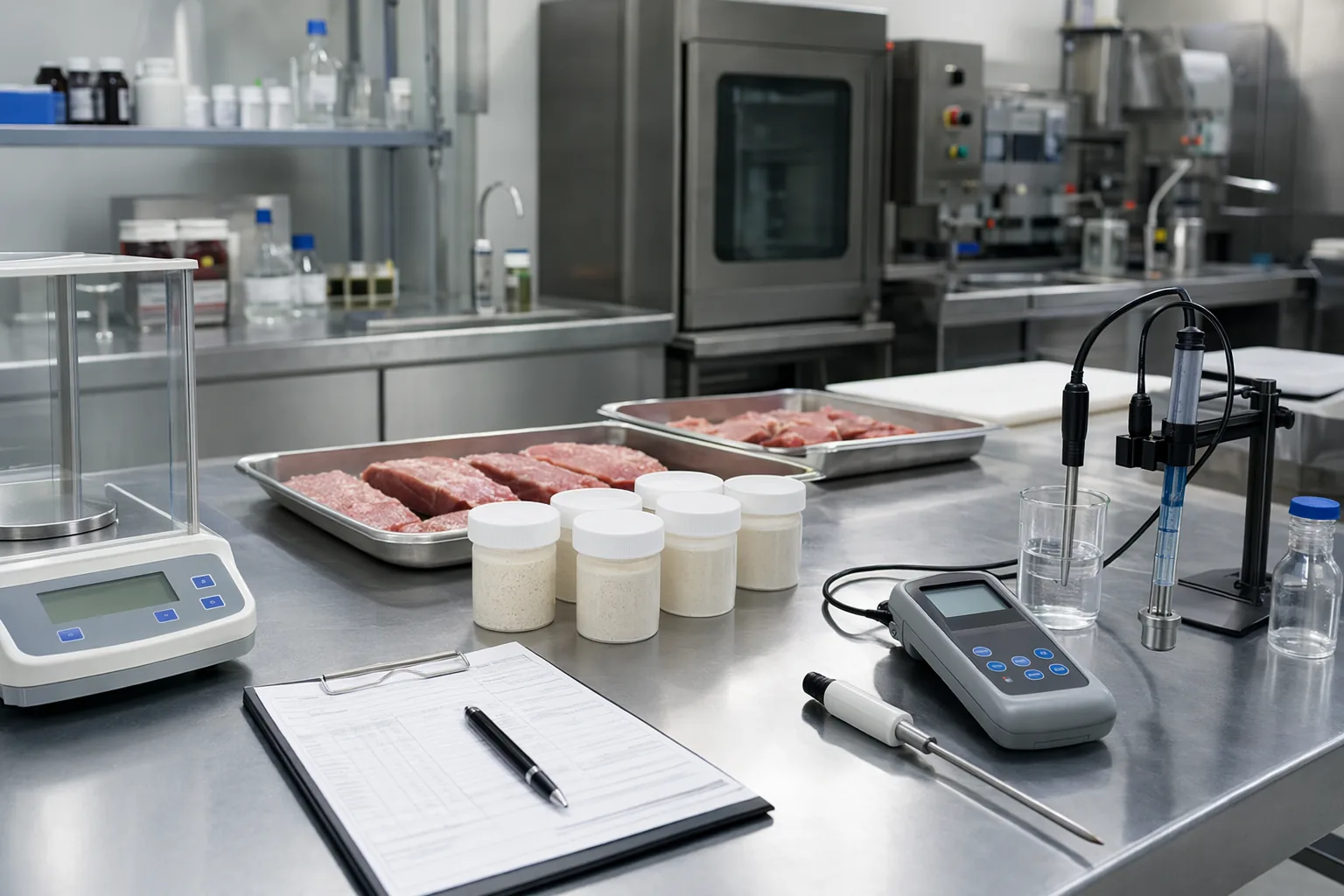
Use this industrial buyer checklist to compare papain enzyme grades, validate performance in meat tenderization, and qualify a papain supplier before scale-up.
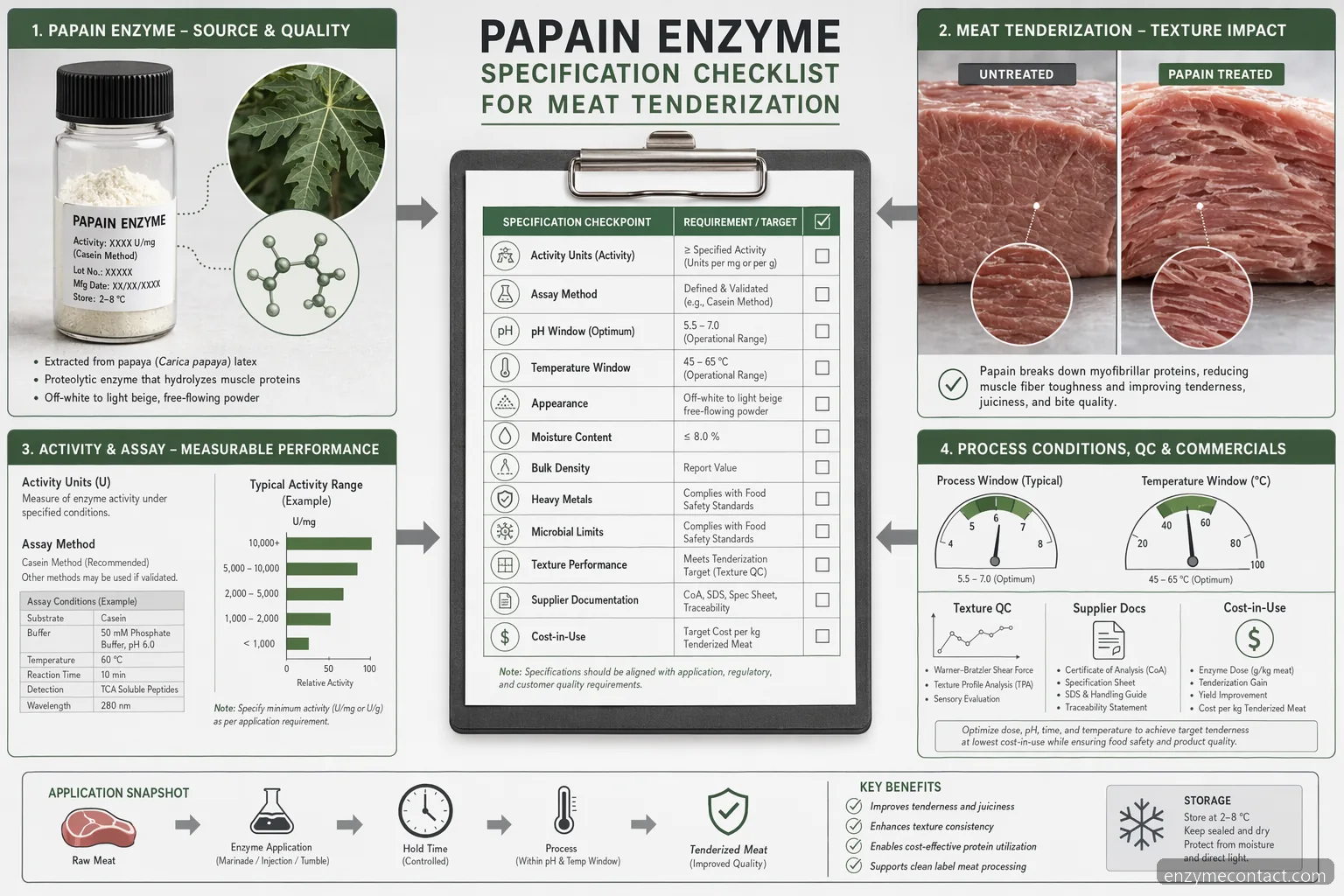
What to Compare Before Choosing Papain
Papain is a cysteine protease derived from papaya latex and used in meat tenderization to hydrolyze muscle proteins and connective tissue. For B2B procurement, the important comparison is not simply “papain enzym kaufen” or lowest unit price. The practical question is whether a papain enzyme grade delivers repeatable tenderization under your plant conditions, product format, labeling needs, and quality system. A supplier should state the activity method, enzyme carrier, appearance, solubility, recommended storage, shelf life, and intended application. If you also source enzymes for brewing or pharmaceutical processing, do not assume the same specification is suitable for injected, tumbled, marinated, or dry-seasoned meat. Food processing grades should be compared against the final process target: bite, sliceability, cook yield, purge, flavor neutrality, and batch consistency.
Define the meat substrate: beef, pork, poultry, seafood, or restructured product. • Confirm whether the papain is powder, granule, or liquid. • Compare lot-to-lot activity variation, not only nominal activity. • Check compatibility with salt, phosphates, sugars, acids, and marinades.
Activity Units and Assay Method Matter
Papain enzyme activity can be reported using different assay substrates, units, and test conditions, so two products with the same number on a label may not perform equally. Ask the papain supplier to explain the assay method used on the COA and how it correlates with meat tenderization performance. Common assay conditions may use casein, hemoglobin, or synthetic substrates at defined pH and temperature; these do not exactly match meat systems but are useful for lot release and comparison. Request typical activity range, minimum guaranteed activity, moisture, ash, heavy metals if relevant to your market, and microbial limits appropriate for food processing. If the supplier cannot provide the test method or release criteria, cost-in-use calculations become unreliable.
Avoid comparing activity values from different assay methods as if they are identical. • Ask for the minimum guaranteed activity at shelf-life end, if available. • Request recent COA examples from multiple lots. • Confirm whether carriers or diluents affect dosing accuracy.
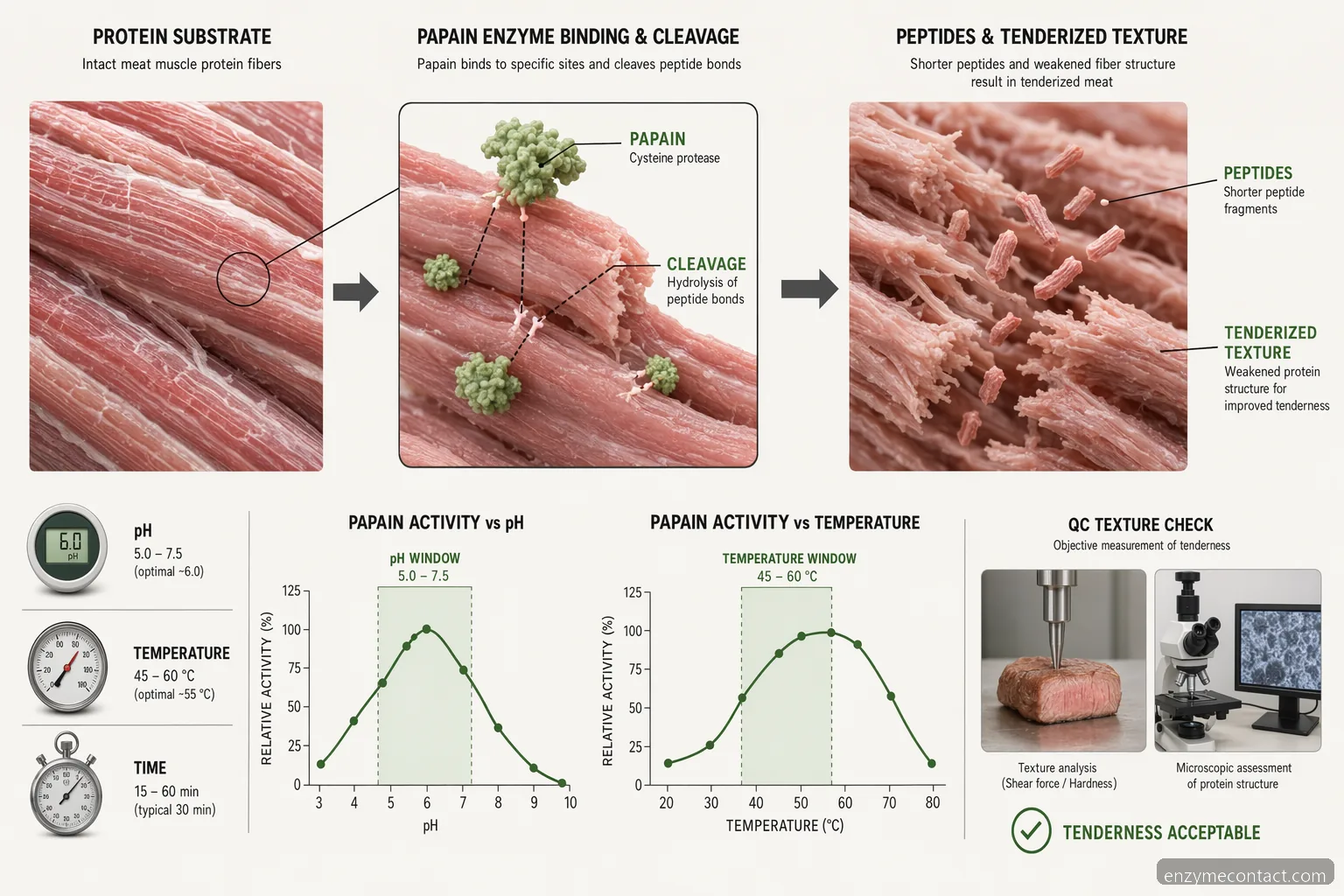
Process Conditions for Meat Tenderization
Papain typically performs in mildly acidic to neutral conditions and remains active across a broad processing window, but exact performance depends on meat type, dosage, particle size, temperature, and contact time. As a starting point for pilot work, many processors screen papain around pH 5.5–7.0, with reaction temperatures from refrigerated marination up to warm processing steps, and faster tenderization as temperature rises. Excessive temperature or long holding can over-tenderize surfaces and create mushy texture. Initial dosage screening is often conducted in low ppm to several hundred ppm active enzyme equivalent, then refined by activity units per kilogram of meat or brine. Use small controlled trials before plant-scale use, especially when injection, vacuum tumbling, or extended marination is involved.
Start with a low, medium, and high dosage ladder in pilot trials. • Measure pH and brine pickup before and after treatment. • Control time and temperature tightly to avoid over-processing. • Validate enzyme inactivation during cooking where applicable.
QC Checks for Tenderization Trials
A good comparison test should include objective and sensory measurements. Use an untreated control, an incumbent enzyme if available, and at least two papain enzyme candidates under identical brine, temperature, pH, and contact-time conditions. Useful QC checks include cook yield, purge loss, slice integrity, shear force, texture profile analysis, visual defects, off-odor, and sensory bite by a trained panel. For injected or tumbled products, confirm distribution uniformity by checking brine pickup and finished-product texture in core and surface samples. Papain enzym wirkung should be assessed as a process effect, not as a supplement claim. If results vary by lot, request retained samples, revised activity normalization, and clarification of storage conditions during transit.
Run side-by-side trials with randomized sample order. • Record actual product temperature, not only room temperature. • Evaluate texture after the intended shelf-life period. • Include cooking and cooling steps used in production.
Documentation and Supplier Qualification
Before approval, request a complete documentation package: COA for the offered lot, TDS with application guidance, SDS for safe handling, allergen statement, GMO statement if required, origin information, storage and shelf-life guidance, packaging specification, and traceability data. Do not rely on broad claims; verify any regulatory or quality-system statements against supplier documents and your market requirements. A qualified papain supplier should support pilot validation, provide batch consistency data, and explain change-control procedures for raw material source, carrier, activity standardization, or manufacturing site. If you compare papain with bromelain or an enzym complex mit bromelain und papain, document why the selected enzyme profile best fits the meat texture target and label requirements.
Request COA, TDS, and SDS before commercial trial purchase. • Confirm food-use suitability for your target market. • Ask about change notification and lot traceability. • Audit or qualify the supplier according to your procurement policy.
Calculate Cost-in-Use, Not Price per Kilogram
The lowest-priced papain may be more expensive if it requires higher dosage, causes inconsistent texture, increases purge, shortens shelf life, or creates handling losses. Cost-in-use should include enzyme activity delivered per kilogram of meat, dosage accuracy, dilution or premix labor, solubility, dust control, storage temperature, shelf life, and yield impact after cooking. Compare candidate enzymes at equivalent tenderization targets rather than equivalent grams added. A concentrated grade may reduce freight and storage cost, while a standardized lower-activity grade may improve dosing precision. For recurring purchase, negotiate around specification stability, documentation speed, lead time, minimum order quantity, and technical support, not only invoice price.
Calculate cost per treated kilogram of meat. • Include yield, purge, rejects, and labor in the comparison. • Confirm lead time and packaging size fit production demand. • Use pilot data before approving long-term supply.
Technical Buying Checklist
Buyer Questions
Compare papain enzyme grades by activity method, guaranteed activity, lot consistency, physical form, documentation, and pilot performance in your product. Price per kilogram is secondary because different assay methods and standardization levels can change the real dosage needed. Ask suppliers for COA, TDS, SDS, recent lot data, and application guidance, then run side-by-side tenderization trials under your actual pH, temperature, and contact-time conditions.
Papain is commonly evaluated in mildly acidic to neutral meat systems, often around pH 5.5–7.0, but the best point depends on marinade composition and meat type. Tenderization generally accelerates as temperature rises, so refrigerated holding, warm processing, and cooking steps must be validated separately. Control time and temperature carefully because excessive activity can cause mushy surface texture, poor sliceability, or inconsistent bite.
No. Searches such as papain enzym kapseln usually refer to consumer capsule formats and are not a specification basis for food manufacturing. Industrial meat processors should evaluate food processing papain with defined activity, carrier, documentation, traceability, and handling requirements. Procurement should focus on process performance, quality documentation, regulatory suitability for the target market, and cost-in-use rather than consumer supplement presentation or dosage language.
Yes, papain can be compared with bromelain or a generic enzym complex mit bromelain und papain, but selection should be based on the desired texture profile and production conditions. Run controlled trials because different proteases may affect surface softening, connective tissue breakdown, flavor perception, and slice integrity differently. Document the selected enzyme system, dosage, and inactivation behavior before approving commercial production.
Supplier qualification should include review of COA, TDS, SDS, traceability, food-use statements, storage guidance, shelf life, packaging, and change-control practices. Request recent lot examples and confirm how activity is standardized. For critical applications, conduct pilot validation and review lead time, minimum order quantity, technical support, and complaint handling. Verify any quality or regulatory claims directly from supplier documents rather than relying on marketing statements.
Papain for Research & Industry
Need Papain for your lab or production process?
ISO 9001 certified · Food-grade & research-grade · Ships to 80+ countries
Frequently Asked Questions
How should industrial buyers compare papain enzyme grades?
Compare papain enzyme grades by activity method, guaranteed activity, lot consistency, physical form, documentation, and pilot performance in your product. Price per kilogram is secondary because different assay methods and standardization levels can change the real dosage needed. Ask suppliers for COA, TDS, SDS, recent lot data, and application guidance, then run side-by-side tenderization trials under your actual pH, temperature, and contact-time conditions.
What pH and temperature conditions are practical for papain meat tenderization?
Papain is commonly evaluated in mildly acidic to neutral meat systems, often around pH 5.5–7.0, but the best point depends on marinade composition and meat type. Tenderization generally accelerates as temperature rises, so refrigerated holding, warm processing, and cooking steps must be validated separately. Control time and temperature carefully because excessive activity can cause mushy surface texture, poor sliceability, or inconsistent bite.
Is papain enzym kapseln relevant to B2B meat processing?
No. Searches such as papain enzym kapseln usually refer to consumer capsule formats and are not a specification basis for food manufacturing. Industrial meat processors should evaluate food processing papain with defined activity, carrier, documentation, traceability, and handling requirements. Procurement should focus on process performance, quality documentation, regulatory suitability for the target market, and cost-in-use rather than consumer supplement presentation or dosage language.
Can papain be compared with bromelain blends for tenderization?
Yes, papain can be compared with bromelain or a generic enzym complex mit bromelain und papain, but selection should be based on the desired texture profile and production conditions. Run controlled trials because different proteases may affect surface softening, connective tissue breakdown, flavor perception, and slice integrity differently. Document the selected enzyme system, dosage, and inactivation behavior before approving commercial production.
What should be included in supplier qualification for papain?
Supplier qualification should include review of COA, TDS, SDS, traceability, food-use statements, storage guidance, shelf life, packaging, and change-control practices. Request recent lot examples and confirm how activity is standardized. For critical applications, conduct pilot validation and review lead time, minimum order quantity, technical support, and complaint handling. Verify any quality or regulatory claims directly from supplier documents rather than relying on marketing statements.
Related: Papain Powder for Commercial Processing
Turn This Guide Into a Supplier Brief Request a papain specification review, sample, and pilot-trial support for your meat tenderization process. See our application page for Papain Powder for Commercial Processing at /applications/papain-powder-commercial/ for specs, MOQ, and a free 50 g sample.
Contact Us to Contribute