Papain Enzyme Powder: Process Guide for Meat Tenderization
Industrial papain enzyme powder guide for meat tenderization: dosage, pH, temperature, QC, COA/TDS/SDS, and supplier checks.
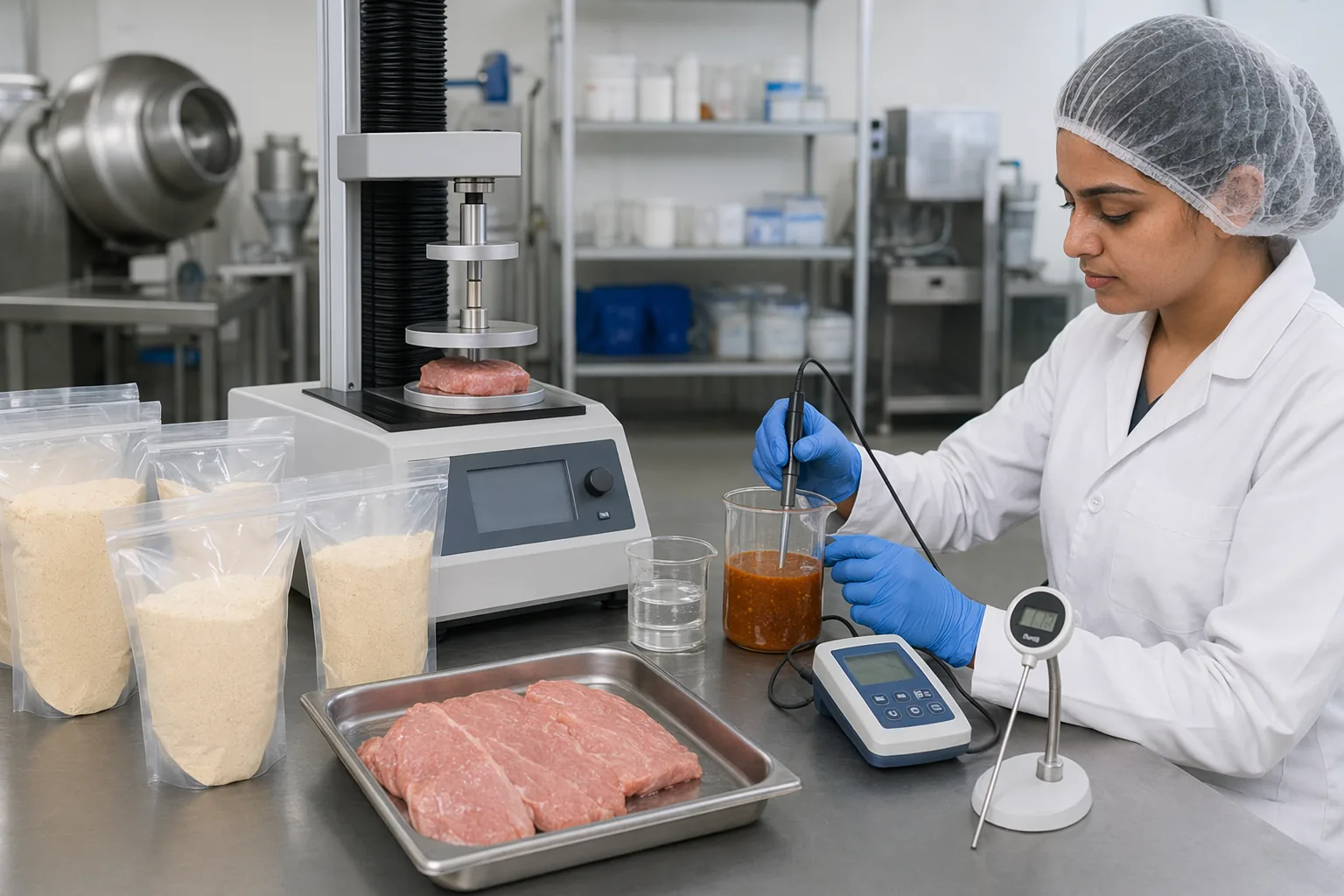
Practical guidance for processors evaluating papain enzyme powder to improve tenderness consistency while controlling yield, texture and cost-in-use. To request a wholesale quote, send the grade or activity you need, the quantity per order or per month, and the destination country to hello@mail.enzymecontact.com, or use the quote form on our home page.
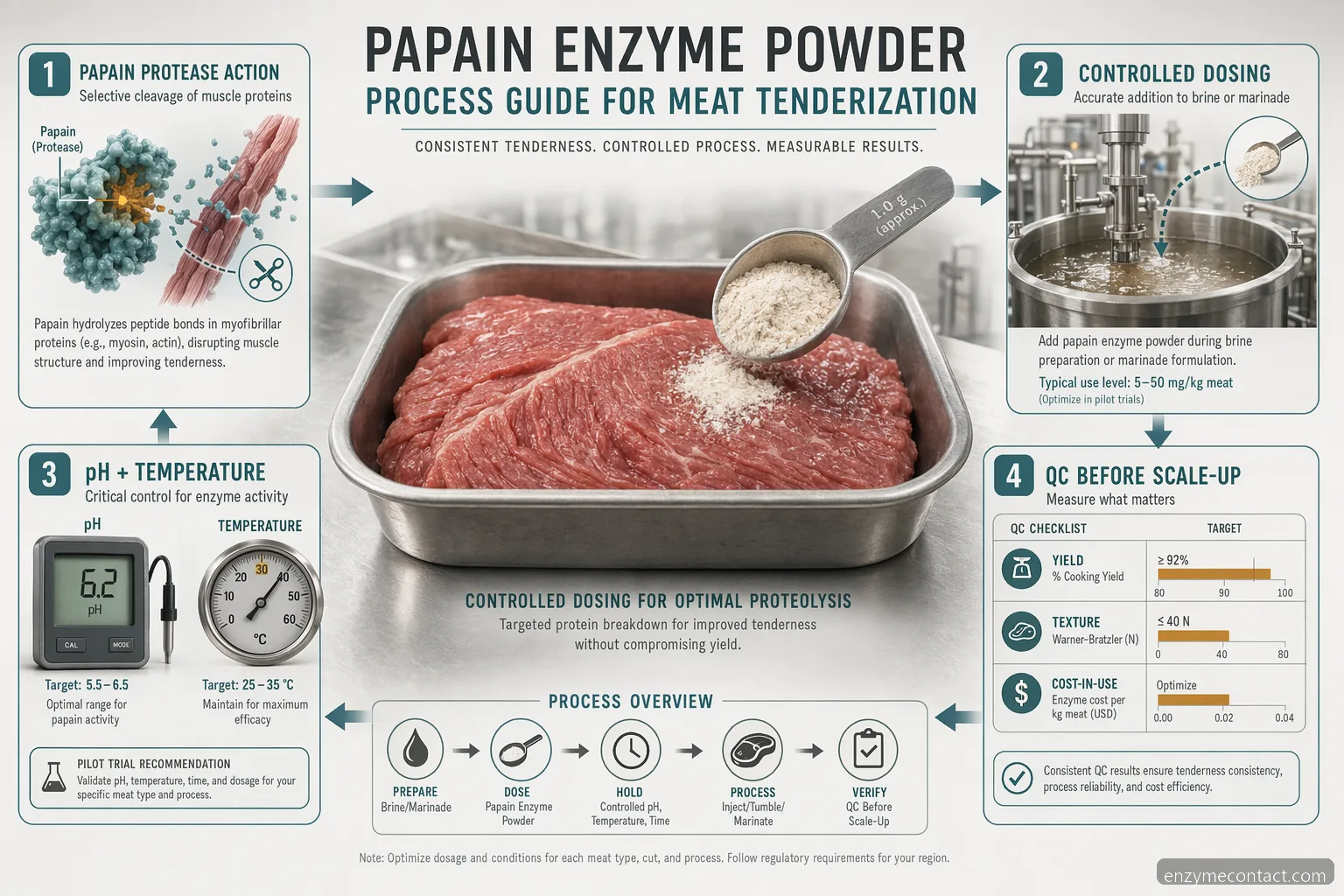
What Papain Enzyme Powder Does in Meat Processing
Papain enzyme powder is a proteolytic enzyme preparation derived from papaya latex and used by meat processors to hydrolyze muscle proteins and connective tissue. In practical terms, papain can help reduce toughness variation in beef, pork, poultry, and processed meat systems when it is dosed and controlled correctly. Unlike mechanical tenderization alone, papain enzyme acts during contact time, so the process window matters as much as the ingredient choice. The target is not maximum breakdown; it is a repeatable bite, acceptable sliceability, and stable cook yield. For B2B buyers, the most important comparison points are activity units, carrier system, solubility, microbiological profile, labeling fit, and lot-to-lot consistency. Papain may also be used in brewing or pharmaceutical processing, but this page focuses on industrial meat tenderization, not dietary supplement or medical use.
Best suited for controlled tenderization of tougher cuts or value-added meat products. • Activity varies by supplier, so dosage must be based on declared units, not powder weight alone. • Over-treatment can reduce texture quality, binding, and slice integrity.
Recommended Process Conditions for Pilot Trials
A practical pilot plan for papain enzyme powder should test several dosage levels under the real plant process. As a starting band, many processors screen 0.02-0.20% as-supplied powder in marinades, brines, or dry blends, then normalize results against the enzyme activity listed on the COA. Papain commonly performs across mildly acidic to neutral conditions, often around pH 5.0-7.5 for meat applications, although supplier data should guide the exact range. Temperature affects reaction speed: chilled tumbling at 2-8°C gives slower, controllable action, while warm treatments around 40-60°C accelerate proteolysis and require shorter hold times. Salt, phosphate, reducing agents, water activity, and contact time can all shift results. Always validate on the specific cut, injection percentage, package format, and cooking schedule used commercially.
Trial dosage: 0.02%, 0.05%, 0.10%, and 0.20% as-supplied powder as a screening matrix. • Typical meat system pH target: about 5.0-7.5, subject to supplier TDS confirmation. • Chilled control: 2-8°C during tumbling or holding to limit excessive reaction. • Accelerated action: 40-60°C only when time and texture are tightly controlled.
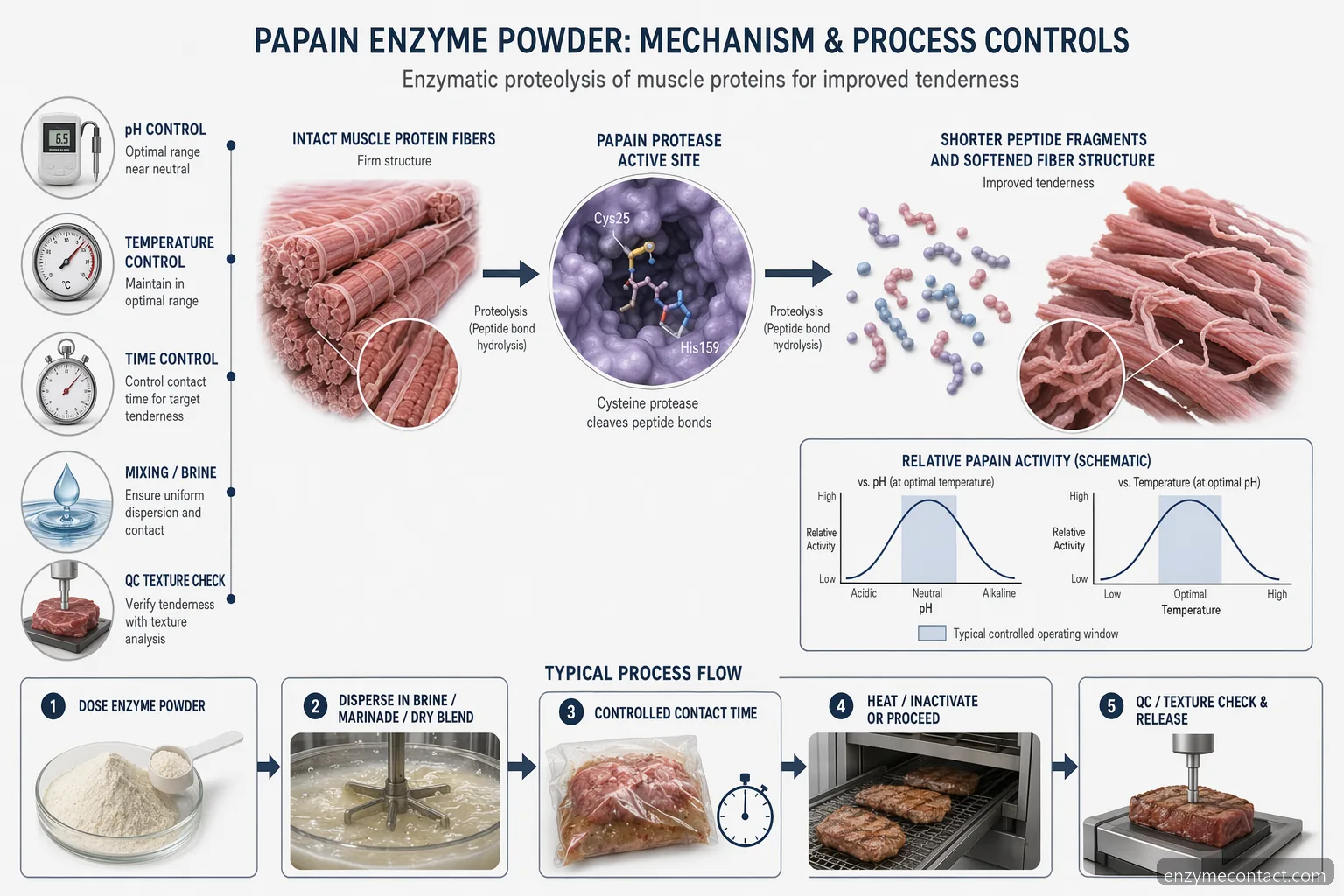
How to Add Papain in Brines, Marinades, and Dry Blends
For injection brines and marinades, pre-disperse papain enzyme powder in cool water or brine under moderate agitation to avoid lumps and uneven treatment. Add the enzyme after high-shear hydration of gums, proteins, or starches if those materials are present, because excessive shear and long mixing may reduce performance depending on formulation. For dry seasoning blends, confirm that the carrier, particle size, and segregation risk are acceptable through storage and dosing. Papain should be distributed uniformly before injection, vacuum tumbling, or coating so that hot spots do not create localized soft texture. When processors search for terms such as buy papain enzyme powder or papain enzyme powder for sale, the supplier should be able to explain whether the product is optimized for direct addition, pre-dispersion, or custom blending.
Use cool water for pre-dispersion unless the TDS recommends otherwise. • Avoid prolonged unnecessary hold time after enzyme addition. • Verify complete dissolution or suspension before injection or spraying. • Check compatibility with salt, phosphate, acids, seasonings, and preservatives.
Quality Control Checks Before Scale-Up
Papain enzyme powder should be evaluated with objective and sensory QC checks, not only visual inspection. Establish a baseline product without enzyme, then compare treated samples at defined time and temperature points. Useful tests include Warner-Bratzler shear force or texture analyzer data, cook yield, purge loss, slice integrity, pH, brine pickup, moisture, and sensory bite evaluation. For cooked products, confirm that the validated thermal process limits continuing enzyme action; many proteases lose activity at high cooking temperatures, but the necessary core temperature and time should be confirmed in the actual product. Microbiological testing is also important because enzyme addition may change process timing or holding conditions. A good pilot report links dosage, activity units, contact time, temperature, and finished-product texture so purchasing can calculate cost-in-use accurately.
Measure tenderness with instrumental texture testing where possible. • Track cook yield and purge to avoid improving tenderness at the expense of margin. • Include untreated controls and at least three enzyme dosage points. • Confirm heat inactivation under the real cook schedule.
Core specification points to request from every supplier
Before you buy papain enzyme powder, request a current Technical Data Sheet, Safety Data Sheet, and sample Certificate of Analysis. The TDS should define enzyme activity method, physical form, recommended pH and temperature range, storage conditions, dosage guidance, and shelf-life basis. The COA should report lot-specific results, not only generic marketing values. For meat applications, common comparison points include declared activity, moisture, particle size, color, odor, carrier or diluent, heavy metals where applicable, and microbiological limits. Ask whether the papain enzyme powder for sale is standardized to a target activity and whether formulation changes are communicated before shipment. If you purchase wholesale papain enzyme powder, confirm packaging integrity, palletization, and container conditions. These details reduce variation between receiving, formulation, and plant-scale production.
COA: lot-specific analytical results. • TDS: processing and storage guidance. • SDS: handling and safety information. • Change control: written notification process.
Supplier Qualification and Documentation
When qualifying a papain supplier, request documentation for every lot and confirm that the declared activity method is understandable and repeatable. A COA should typically include enzyme activity, appearance, moisture or loss on drying, microbiological limits, and relevant contaminant data for the intended market. The TDS should define recommended pH, temperature, solubility, dosage, storage, shelf life, and handling precautions. The SDS should cover occupational safety, dust control, and exposure considerations for plant personnel. Buyers comparing wholesale papain enzyme powder offers should avoid judging by price per kilogram alone. The better metric is cost-in-use at validated activity, including waste reduction, rework risk, technical support, lead time, and lot consistency.
Request COA, TDS, SDS, allergen statement, and lot traceability before approval. • Compare enzyme activity units and test methods, not only powder price. • Ask for retained sample policy, shelf-life data, and storage recommendations. • Run incoming QC checks on critical lots before full production release.
Cost-in-Use and Purchasing Considerations
The lowest-priced papain enzyme powder is not always the lowest-cost option for industrial meat tenderization. Because papain enzyme activity, carrier level, solubility, and stability can differ, two powders used at the same percentage may deliver different texture outcomes. Calculate cost-in-use by dividing the delivered cost by the number of finished kilograms treated at the validated dose, then include yield impact, trimming reduction, downgrade reduction, rework, and rejection risk. Procurement should also evaluate minimum order quantity, packaging size, moisture protection, lead time, technical response speed, and ability to support pilot validation. If your team is preparing to buy papain enzyme powder for routine production, align purchasing, QA, R&D, and operations on one written specification so substitutions do not change the process unexpectedly.
Use validated dose per metric ton of finished product for cost comparisons. • Include yield, texture defects, and process downtime in the purchasing model. • Define approved storage, packaging, and shelf-life requirements in the specification. • Require change notification for activity, carrier, origin, or manufacturing process updates.
Papain for Research & Industry
Need Papain for your lab or production process?
ISO 9001 certified · Food-grade & research-grade · Ships to 80+ countries
Frequently Asked Questions
What is the best dosage for papain enzyme powder in meat tenderization?
There is no universal best dosage because activity units, meat cut, pH, temperature, contact time, and target bite all matter. A practical screening range is 0.02-0.20% as-supplied papain enzyme powder, tested against an untreated control. Final dosage should be based on pilot texture data, yield results, and the activity listed on the supplier COA.
Can papain enzyme powder be used in injection brines?
Yes, papain can be used in injection brines when it is properly dispersed and validated for the equipment and product. Use cool water or brine, moderate agitation, and confirmed solubility or suspension before injection. Monitor brine pickup, needle distribution, purge, texture, and cook yield. Uneven mixing or excessive hold time can cause inconsistent tenderness or localized soft spots.
What documents should a papain supplier provide?
A qualified supplier should provide a COA for each lot, a TDS describing activity and use conditions, and an SDS for handling and workplace safety. Buyers should also request lot traceability, allergen information, storage guidance, shelf-life details, and any relevant microbiological or contaminant data. These documents support QA approval and help standardize purchasing specifications.
How do we prevent over-tenderization with papain enzyme?
Prevent over-tenderization by controlling dose, pH, temperature, and contact time together. Run pilot batches at multiple dosage levels, hold samples under real plant conditions, and measure texture at defined intervals. Chilled processing can slow reaction rates, while warm conditions require tighter timing. Confirm the cooking step sufficiently limits further proteolysis in the finished product.
How should we compare papain enzyme powder suppliers?
Compare suppliers by activity-normalized cost-in-use, not only price per kilogram. Review COA activity method, lot consistency, solubility, carrier system, microbiological profile, packaging, shelf life, lead time, and technical support. A supplier that helps with pilot validation and change control may reduce operational risk even if the powder price is not the lowest.
Request a Wholesale Quote for Papain Powder
Send the grade or activity, quantity and destination country. We quote 1 kg, 5 kg and 25 kg packs for processors, blenders and resellers, with a free sample for qualified inquiries. Specification: /applications/papain-powder-commercial/. See our application page for Papain Powder for Commercial Processing at /applications/papain-powder-commercial/ for specs, MOQ, and a free 50 g sample.
Contact Us to Contributehello@mail.enzymecontact.com